
ALUMINIUM CASTINGS
Manufacturing of aluminium castings weighing from 0.5 to 120 kg according
to customer drawings
PRITZ DEVELOPMENT manufactures aluminium alloy castings for the machinery industry, industrial equipment
manufacturing and other industries.
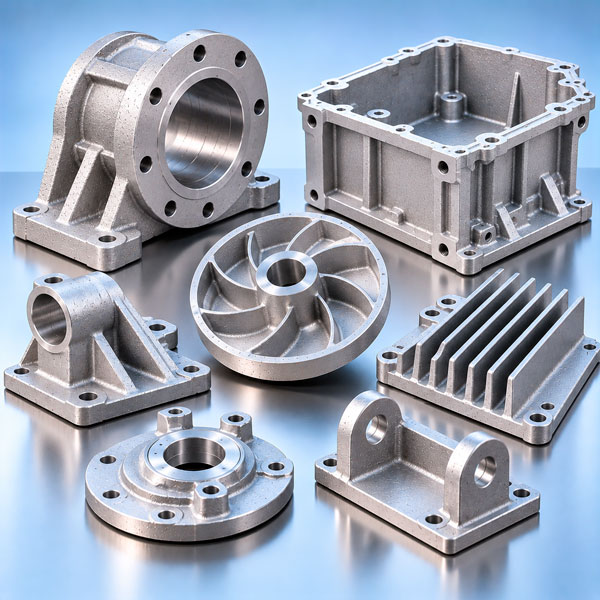
Aluminium casting allows the production of lightweight parts with complex shapes, internal cavities,
stiffening ribs and functional structural features.
PRITZ provides technical support during order fulfillment, coordinates casting production, arranges
subsequent machining and delivers castings or finished parts in accordance with customer documentation.
Technical capabilities
Materials:
- Aluminium casting alloys.
Casting weight:
- from 0.5 to 120 kg.
Additional operations:
- Design and manufacture of pattern and foundry tooling.
- Casting cleaning and removal of gates and risers.
- Heat treatment.
- Turning, milling, drilling and boring.
- Verification of chemical composition, geometric dimensions and mechanical properties.
- Non-destructive testing in accordance with the requirements of the technical documentation.
During technical preparation of the order, the alloy grade, casting method, dimensional tolerances, surface quality requirements and inspection scope are determined.
What products is aluminium casting used for
Aluminium casting is widely used to manufacture parts for machinery and industrial equipment where low weight, thermal conductivity, corrosion resistance and the ability to achieve complex geometries are important.
Main product types:
- Reduction gearbox and drive housings — lightweight housings with seating surfaces, stiffening ribs and internal cavities.
- Electric motor housings — cast housings, end covers, bearing end shields and cooling components.
- Heat sinks and heat-dissipating components — parts with an extended heat transfer surface for electrical and industrial equipment.
- Pump and compressor housings — housings, covers, flanges and unit components.
- Brackets and support components — structural machine parts, mounting assemblies and fasteners.
- Electronic equipment housings — protective covers, mounting bases and parts requiring heat dissipation.
- Parts for transport equipment — mechanism housings, supports, covers and structural components subject to weight restrictions.
- Spare parts for industrial equipment — cast blanks and finished parts for machine repair and modernization.
The selection of alloy and manufacturing process depends on operating conditions, mechanical loads, accuracy requirements and the intended use of the part.
Advantages of aluminium casting
- Low product weight.
The density of aluminium alloys is significantly lower than that of steel and cast iron, allowing the weight of structures to be reduced. - Good castability.
Many aluminium casting alloys allow parts with complex geometries, thin walls and internal cavities to be produced. - High thermal conductivity.
Suitable for manufacturing housings with heat-dissipating features and parts for heat exchange equipment. - Corrosion resistance.
The formation of a natural oxide layer protects the surface under many operating conditions. - Good machinability.
Most aluminium casting alloys are suitable for high-productivity machining. - Suitability for series production.
Permanent mould casting enables dimensional repeatability and manufacturing process stability. - Complex product geometry.
A single aluminium casting can combine several structural elements in one part.
Process limitations
The following characteristics must be taken into account when designing and manufacturing aluminium castings:
- Shrinkage phenomena.
Shrinkage porosity and shrinkage cavities can form during alloy solidification, requiring proper design of the gating and feeding system. - Gas porosity.
Hydrogen dissolved in the molten alloy can cause pores to form, making control of the molten alloy’s quality necessary. - Oxide inclusions.
Failure to follow melting and pouring procedures may lead to oxide films entering the casting metal. - Operating temperature limitations.
The mechanical properties of many aluminium alloys deteriorate at elevated temperatures. - Part design requirements.
Wall thickness, smooth transitions, draft angles and mould filling conditions must be taken into account. - The need for machining.
Achieving accurate seating dimensions, holes and mating surfaces usually requires additional machining. - Production tooling costs.
The cost of patterns, core boxes and especially permanent moulds affects the economic viability of production.
Manufacturing aluminium castings
PRITZ DEVELOPMENT produces custom aluminium castings at specialized partner facilities according to the customer’s drawings, 3D models and technical documentation.
Work begins with an analysis of the part design and material requirements. The selection of the manufacturing process takes into account the intended use of the part, required accuracy, surface quality and batch size. On this basis, the feasibility of one-off or series production is assessed.
If the project involves aluminium pressure die casting, the feasibility of using this process requires a separate assessment and agreement with the partner foundry. The analysis covers the part design and weight, alloy type, planned production volume and tooling costs.
If necessary, tooling is designed and manufactured to allow for casting shrinkage, draft angles and machining allowances. Casting patterns, core boxes or permanent moulds are selected to suit the chosen manufacturing process and part design.
Once the casting has been produced, cleaning, heat treatment if necessary, and turning, milling, drilling and boring operations can be carried out.
Quality control is organized in accordance with the requirements of the technical documentation. It may include verification of material properties, dimensional inspection and testing to detect casting defects. The inspection scope and casting assessment criteria are established during order preparation.
Typical production process sequence:
Drawing analysis → Process selection → Tooling manufacture → Casting → Cleaning → Heat treatment → Machining → Quality control → Delivery of finished parts.
The quotation for an aluminium casting is based on technical documentation defining the part geometry, material requirements and scope of further processing. Technical drawings and 3D models allow the feasibility of manufacturing the part according to the customer’s drawing to be assessed and the necessary production operations to be determined.
Why PRITZ DEVELOPMENT
Series production repeatability
Stability of dimensions, geometry and product quality across successive batches.
Full production cycle
Core metalworking operations are carried out within a single production process.
Working from customer documentation
Production is organized based on agreed drawings and technical requirements.
Production of pre-series batches
Before launching regular production, the manufacturing process and product can be checked using a
limited batch.
ISO 9001
A quality management system with a valid certificate.
Headquarters in Poland
PRITZ DEVELOPMENT is headquartered in Katowice and focuses on cooperation with B2B customers in
Poland and the EU.
Order aluminium casting
Manufacturing of castings and finished parts weighing from 0.5 to 120 kg according to customer drawings
Send technical drawings, 3D models or a technical specification stating the part weight, required quantity and requirements for mechanical properties, dimensional accuracy, further processing and quality control.
PRITZ DEVELOPMENT specialists will carry out a technical assessment of the order, agree on the manufacturing process with the foundry and prepare a commercial offer.
The price of an aluminium casting depends on the alloy grade, part weight and complexity, batch size, tooling costs and scope of processing and inspection. The casting quotation takes into account both production preparation and the agreed additional operations.