
CAST IRON CASTINGS
PRITZ DEVELOPMENT produces custom cast iron castings for the machinery industry, industrial equipment
manufacturers and other industries.
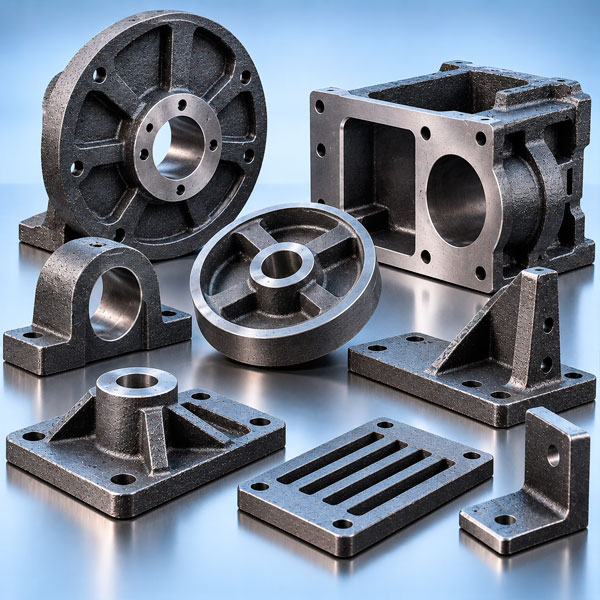
Cast iron casting allows the production of parts with complex shapes, internal cavities, stiffening
ribs, projections and heavy structural components.
PRITZ provides technical support during order fulfillment, coordinates casting production, arranges
subsequent machining and delivers castings or finished parts in accordance with customer documentation.
Technical capabilities
Materials:
- Grey cast iron.
Casting weight:
- from 0.5 to 1500 kg.
Manufacturing processes:
- Casting in moulds made from cold-setting, self-hardening mixtures.
- Casting in traditional sand moulds.
Additional operations:
- Design and manufacture of pattern equipment and foundry tooling.
- Casting cleaning and removal of gating systems and risers.
- Heat treatment.
- Turning, milling, drilling and boring.
- Verification of chemical composition, geometric dimensions and mechanical properties.
- Non-destructive testing in accordance with the requirements of the technical documentation.
The cast iron grade, manufacturing method, dimensional tolerances, required surface quality and inspection scope are determined during technical preparation of the order.
The capabilities described apply to grey iron castings. If the project involves ductile iron castings, manufacturing feasibility requires separate confirmation based on the technical documentation and agreements with the partner foundry.
What products is cast iron casting used for
Cast iron castings are widely used in the machinery industry thanks to the material’s good castability, excellent machinability and vibration-damping capacity.
Main product types:
- Reduction gearbox and drive housings — housings with seating surfaces, internal cavities and stiffening ribs.
- Machine tool beds and bases — heavy structural components that provide equipment with rigidity and vibration resistance.
- Pump and compressor housings — cast housings, covers, supports and other equipment components.
- Bearing housings — shaft supports, bearing assembly housings and mounting components.
- Pulleys and flywheels — parts for mechanical transmissions and drive systems.
- Equipment plates and bases — mounting plates, support surfaces and structural components.
- Parts for ventilation and industrial equipment — housings, supports, covers and mechanism components.
- Spare parts for machinery — manufacturing cast iron parts for the repair and modernization of industrial equipment.
Grey iron casting is particularly appropriate for parts operating primarily under compressive and static loads, as well as structures where rigidity, vibration damping and geometric stability are important.
Advantages of cast iron casting
- Good castability.
Grey cast iron has high fluidity and allows castings with complex geometries to be produced. - Effective vibration damping.
The presence of graphite in the microstructure of grey cast iron provides effective damping of mechanical vibrations. - Good machinability.
The material is suitable for turning, milling, drilling and boring. - High compressive strength.
This allows cast iron to be used to manufacture heavy bases, machine tool beds and support parts. - Complex product geometry.
The ability to produce housings with internal cavities, stiffening ribs and changes in cross-section. - Cost-effectiveness.
For many housing and structural parts, cast iron casting provides a reasonable balance between material, manufacturing and subsequent processing costs. - One-off and series production.
Casting in sand moulds and moulds made from cold-setting, self-hardening mixtures allows the manufacture of individual parts and production batches.
Process limitations
The following characteristics must be taken into account when designing and manufacturing cast iron castings:
- Material brittleness.
Grey cast iron has relatively low ductility and limited resistance to impact and tensile loads. - Potential casting defects.
Failure to follow manufacturing procedures may lead to porosity, cavities, non-metallic inclusions and cracks. - Microstructural non-uniformity.
Cooling rate and wall thickness may affect the microstructure, hardness and mechanical properties of cast iron. - Design limitations.
Minimum wall thickness, smooth transitions, draft angles and mould filling conditions must be taken into account. - The need for machining.
Achieving accurate seating dimensions, holes and mating surfaces usually requires additional machining. - Production tooling costs.
The manufacture of patterns, core boxes and permanent moulds affects the cost of the order. - Duration of the production cycle.
Tooling preparation, mould production, pouring, cooling, cleaning and inspection affect the order lead time.
Manufacturing cast iron castings
PRITZ DEVELOPMENT manufactures grey iron castings at specialized partner facilities according to the customer’s drawings, 3D models and technical documentation.
Work begins with an analysis of the part design. The selection of the cast iron grade and manufacturing process takes into account operating conditions, required mechanical properties and the scope of subsequent processing.
If necessary, pattern equipment is designed and manufactured taking into account draft angles, solidification characteristics and machining allowances. Tooling, including patterns and core boxes, is selected to suit the part design and chosen manufacturing process. Casting moulds and the required cores enable the external geometry and internal cavities of the casting to be reproduced.
Once the casting has been produced, cleaning, heat treatment to reduce internal stresses, and turning, milling and boring operations can be carried out.
Quality control is organized in accordance with the requirements of the technical documentation and may include verification of chemical composition and mechanical properties, as well as detection of casting defects. Dimensional inspection is used to check part geometry and compliance with the agreed dimensional tolerances.
Typical production process sequence:
Drawing analysis → Process selection → Tooling manufacture → Casting → Cleaning → Heat treatment → Machining → Quality control → Delivery of finished parts.
Depending on the order, unmachined castings or fully machined parts ready for further assembly and use can be supplied. The scope of work for manufacturing parts according to the customer’s drawing is determined before production begins.
Why PRITZ DEVELOPMENT
Series production repeatability
Stability of dimensions, geometry and product quality across successive batches.
Full production cycle
Core metalworking operations are carried out within a single production process.
Working from customer documentation
Production is organized based on agreed drawings and technical requirements.
Production of pre-series batches
Before launching regular production, the manufacturing process and product can be checked using a
limited batch.
ISO 9001
A quality management system with a valid certificate.
Headquarters in Poland
PRITZ DEVELOPMENT is headquartered in Katowice and focuses on cooperation with B2B customers in
Poland and the EU.
Order cast iron casting
Manufacturing of cast iron castings and finished parts weighing from 0.5 to 1500 kg according to customer drawings
Send technical drawings, 3D models or a technical specification stating the cast iron grade, casting weight, required quantity and requirements for machining and quality control.
PRITZ DEVELOPMENT specialists will carry out a technical assessment of the order, agree on the manufacturing process with the foundry and prepare a commercial offer.
The casting quotation takes into account the cast iron grade, part weight and complexity, batch size, the costs of pattern equipment and other tooling, and the scope of processing and quality control.