
FOUNDRY PRODUCTION
Steel, cast iron and non-ferrous metal castings according to customer documentation
PRITZ DEVELOPMENT supplies custom metal castings — parts and semi-finished products according to customer
drawings, 3D models and technical documentation, with subsequent machining if required.
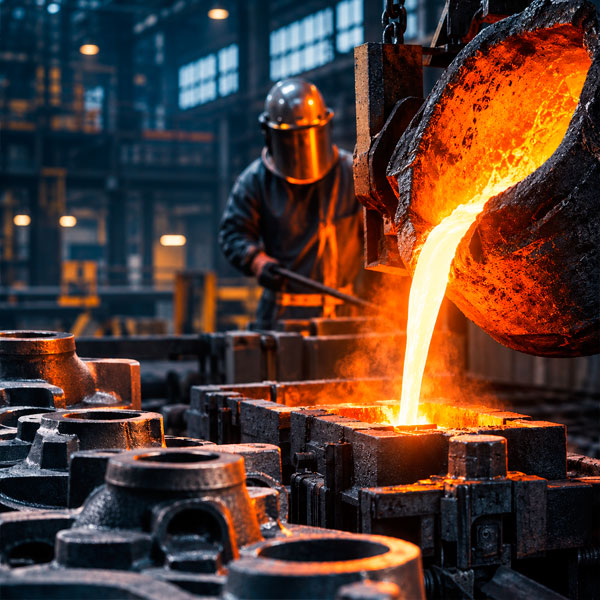
We manufacture custom castings from cast steel, cast iron and non-ferrous metals in sand moulds
(using moulding sand) and permanent moulds.
Types of castings
Manufacture of steel castings for machine assemblies, housings, equipment parts and other key components.
The cast steel grade can be selected according to the drawing requirements, technical specifications and operating conditions of the part.
Steel castings
Material: carbon cast steel, low-alloy cast steel.Casting weight: from 10 to 1500 kg. MORE 02
Cast iron castings
Material: grey cast ironCasting weight: from 0.5 to 1500 kg. MORE 03
Casting from aluminum
Material: aluminium alloysCasting weight: from 0.4 to 120 kg. MORE 04
Non-ferrous metal castings
Material: copper-bronze alloysCasting weight: from 0.4 to 120 kg. MORE
From a cast blank to a finished part
A metal casting can be supplied as a semi-finished product or, after machining, as a finished part that conforms to the drawing.
This makes it possible to obtain a finished part that conforms to the customer’s drawing without having to coordinate cooperation between the foundry and the machining facility yourself.
Possible sequence of production stages:
1. Analysis of the drawing and technical documentation.
2. Selection of the material and manufacturing process.
3. Manufacture of the cast blank.
4. Cleaning and preparation of the casting.
5. Heat treatment — if necessary and in accordance with the requirements for the part.
6. Machining.
7. Dimensional inspection and quality control.
8. Kitting and preparation of products for shipment.
Production based on customer documentation
Work begins with an analysis of the technical documentation.
For a preliminary assessment, it is sufficient to provide:
- a part drawing;
- a 3D model;
- the material grade;
- the required number of pieces;
- mechanical property requirements;
- machining requirements;
- inspection and quality requirements.
If the documentation includes requirements for a specific manufacturing process, these are taken into account when preparing the quotation.
For products manufactured in series, the manufacturing process and cast blank parameters can be agreed before production begins.
We manufacture tooling for foundry production (cast steel moulding boxes, welded moulding boxes, permanent moulds) and pattern sets made from wood and aluminium alloys.
The metal casting is inspected in accordance with the documentation requirements. We agree on the scope of testing for each project.
Quality control methods used: rapid chemical composition analysis, chemical analysis, mechanical testing, microstructural examination, photocolorimetry, leak testing, ultrasonic testing, dye penetrant testing, dimensional accuracy inspection, pouring temperature monitoring, testing of moulding and core material properties, spectral analysis, magnetic particle testing.
Additional capabilities: heat treatment, machining, design and manufacture of pattern equipment on a TWISTERSX five-axis machining centre
What applications is this production suitable for
Casting and machining capabilities can be used to manufacture:
- housings and housing parts;
- covers and bases;
- machine and mechanism parts;
- gear and drive components;
- supports and brackets;
- working components of equipment;
- large machine parts;
- spare parts;
- other cast parts according to customer drawings.
The main area of activity is industrial and machinery manufacturing, including one-off, small-batch and series production of parts, depending on the nature of the project.
Machining of cast parts
After the casting has been produced, machining can be carried out to obtain a finished part that conforms to the drawing.
Machining is performed using lathes, milling machines, boring machines and other metalworking machine tools.
For machining large parts, the production facility has modern equipment capable of processing components of considerable dimensions and weight. In particular, the facility uses a DOOSAN DBC160 five-axis horizontal boring machine designed to machine parts weighing up to 2 tonnes and measuring up to 4 metres in length.
Depending on the project, a full production cycle can be organized:
Casting → heat treatment → machining → inspection → finished part.
ADVANTAGES OF PRODUCTION AT PRITZ DEVELOPMENT
One manufacturing partner for the entire product
Full production cycle
Working from customer documentation
Production of parts and products according to drawings, 3D models and specifications.
Production repeatability
Consistent manufacture of identical components and products.
Production of trial units
Verification of the design and manufacturing process before launching series production.
Assembly of finished products
The option to receive a finished assembly or product instead of individual parts.
Quality control
Product inspection during manufacturing and before delivery.
ISO 9001
An implemented quality management system confirmed by certification.
A company headquartered in Poland
PRITZ DEVELOPMENT is headquartered in Katowice and focuses on B2B projects in Poland and EU countries.
HOW WE FULFIL AN ORDER
From a drawing to a finished part, assembly or product
01 — Documentation
We receive drawings, 3D models and specifications.
02 — Technical analysis
We check the design and manufacturability.
03 — Quotation
We determine the production process sequence and cost.
04 — Trial unit / pre-production run
We manufacture a trial unit or a small batch.
05 — Approval
We agree on the design and quality.
06 — Series production
We launch regular production.
07 — Assembly and inspection
We assemble the units and inspect the finished products.
08 — Packaging and delivery
We prepare the products for shipment.
FOUNDRY PRODUCTION
If you have a drawing of a cast part, a 3D model or a specification, send the documentation — we will forward it for technical assessment and prepare a production quotation.